
Conservatory roof replacement costs 3 to 8 times less than demolishing and rebuilding - and achieves 90% of the same outcome in terms of comfort, appearance, and added property value. For most Liverpool homeowners, the question of whether to replace or demolish comes down to one thing: the condition of the existing walls, windows, and frame. If the structure is sound, a roof replacement is the clear winner on every measure that matters. This guide compares both options honestly so you can make an informed decision.
What Does Conservatory Roof Replacement Involve?
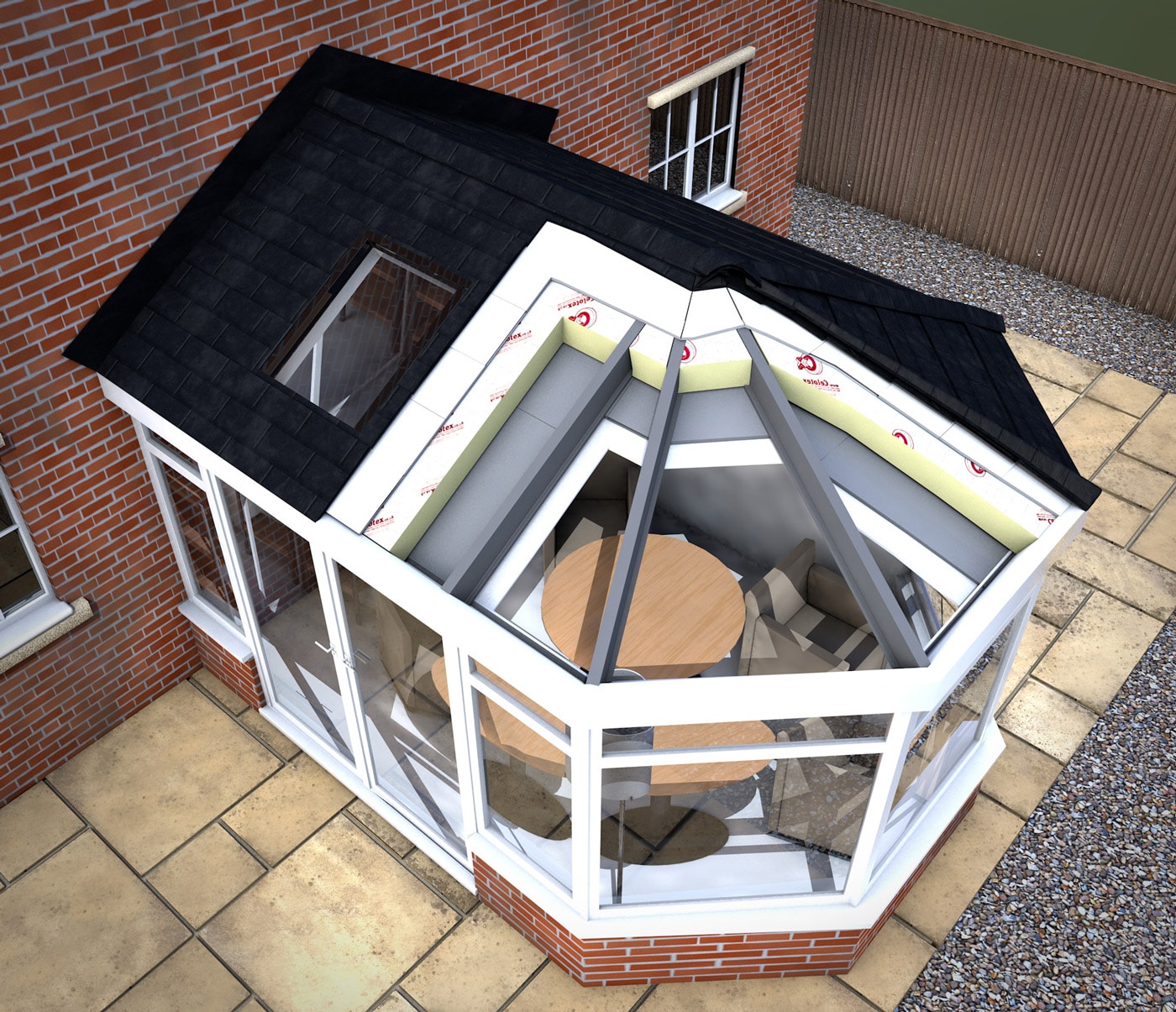
A conservatory roof replacement involves removing the existing glazed or polycarbonate roof down to the wall plate level, then installing a new lightweight insulated roof system in its place. The existing walls, windows, doors, and frame remain entirely intact. This is the critical distinction between replacement and demolition - the structural envelope of the conservatory stays, and only the roof is upgraded.
A typical roof replacement takes between 3 and 5 days from start to finish. There is no requirement to vacate the property during the works, and disruption to the rest of the home is minimal. The finished result is a solid, plastered ceiling internally and a tiled or lightweight roof covering externally, indistinguishable in appearance from a room extension. For a full breakdown of the process, see our conservatory roof conversion page.
What Does Conservatory Demolition and Rebuild Involve?
A full demolition and rebuild is exactly as it sounds: the entire conservatory structure is demolished down to ground level, the existing slab and footings are assessed and often replaced, and a completely new extension is built from foundations upward. This is effectively a new-build room extension and carries all the associated complexity, timescale, and cost.
A full rebuild typically takes between 8 and 16 weeks depending on the size of the structure, weather conditions, and the complexity of the design. During the structural build phase, the opening into the house will need to be sealed temporarily, restricting access to the rear garden and causing significant disruption. A full demolition and rebuild is a substantially more costly undertaking than a roof replacement, rising further if the design is enlarged or structural complications are encountered.
How Do the Costs Compare?
The cost difference between the two options is substantial. A conservatory roof replacement is significantly less expensive than a full demolition and rebuild, often by a factor of several times, for a very similar end result.
The cost gap widens further when you factor in the ancillary costs of a full rebuild: planning application fees, architect or designer fees, skip hire, structural engineer fees, temporary weatherproofing of the house opening, and the extended project management time. None of these apply to a roof replacement. Request a free quote to see what a replacement would cost for your property, or visit our conservatory roof cost guide for a general overview.
Which Option Requires Planning Permission?
Conservatory roof replacement typically falls within permitted development rights, meaning planning permission is not required in most cases. Provided the existing conservatory was lawfully constructed and the new roof does not exceed the original footprint or height, the work can proceed without a planning application. Building regulations approval is still required, but this is a separate and more straightforward process.
A full demolition and rebuild almost always requires full planning permission unless the new structure qualifies as permitted development - which is subject to strict conditions around size, height, and proximity to boundaries. The planning process adds 8 to 10 weeks to the project timeline and introduces the risk of refusal, conditions, or the requirement to redesign. For a thorough explanation of what triggers planning permission for conservatory work, see our planning permission guide.
Which Provides Better Thermal Performance?
Both a roof replacement and a full rebuild can achieve similar thermal performance levels in the finished space. A quality insulated roof replacement achieves a U-value of 0.15 to 0.18 W/m2K, which meets and exceeds current building regulations requirements. A new-build room extension would target similar U-values for the roof element, with the additional insulation in new walls providing marginal gains.
In practice, the limiting factor for thermal performance in most conservatories is not the roof but the existing glazed walls. A roof replacement transforms the overhead heat loss, which is the dominant source of discomfort in summer and winter. The walls and glazing can be addressed separately if required, but the roof replacement alone delivers transformational improvement in year-round comfort. For details on insulation performance, see our conservatory roof insulation page.
Which Is Better for Property Value?
Both a well-executed roof replacement and a high-quality rebuild add property value when the space is genuinely usable year-round. However, the return on investment is dramatically different. A roof replacement at a fraction of the cost of a rebuild that achieves a similar measurable increase in property value represents far superior financial sense.
Estate agents consistently report that conservatories with solid insulated roofs are presented as full reception rooms and valued accordingly, while glazed or polycarbonate-roofed conservatories are discounted or treated as conditional space. The roof is the key variable. To understand the full value case for roof replacement, see our page on whether conservatory roof replacement is worth it.
When Should You Consider Full Demolition?
Full demolition and rebuild is only the right choice in a limited set of circumstances. If the existing conservatory has suffered structural damage beyond economic repair - severe subsidence, frame failure, or rot in timber structures - then the existing walls cannot safely support a new roof and the structure must come down. Similarly, if the footings have failed or the original slab is cracked and settling, no roof replacement can address the underlying problem.
A second legitimate reason to consider demolition is a genuine planning gain opportunity: if you want to significantly enlarge the footprint, change the design substantially, or convert to a full brick extension with no glazed elements, then a rebuild makes sense. However, in the vast majority of cases - where the existing structure is fundamentally sound and the goal is simply to make the space comfortable and attractive - a roof replacement delivers equivalent results at a fraction of the cost and disruption.