
Conservatory vs Orangery: Key Differences, Costs and Which Is Right for You
The main difference between a conservatory and an orangery is structural - a conservatory is predominantly glazed while an orangery has solid walls with a glazed roof lantern, making orangeries warmer but more expensive to build. This comparison guide covers the practical differences in construction, planning requirements, thermal performance, cost, and property value - along with the option that many homeowners overlook: upgrading an existing conservatory to perform like an orangery at a fraction of the cost of a new build.
What Is the Difference Between a Conservatory and an Orangery?
The distinction comes down to the proportion of glazing in the structure and how the roof is constructed.
Conservatory
A conservatory is defined as a structure where at least 75 per cent of the roof and 50 per cent of the walls are glazed. The roof is typically pitched, using polycarbonate or glass panels supported by uPVC or aluminium glazing bars. This high proportion of glazing maximises natural light but creates the thermal problems - overheating in summer, cold in winter - that most owners experience.
Orangery
An orangery has solid brick or block perimeter walls - usually matching the house - with a flat or low-pitch roof incorporating a central glazed lantern. The solid wall construction provides better insulation and a more "room-like" feel, while the roof lantern maintains a sense of natural light and connection to the outside. Orangeries feel more like extensions and less like glass additions.
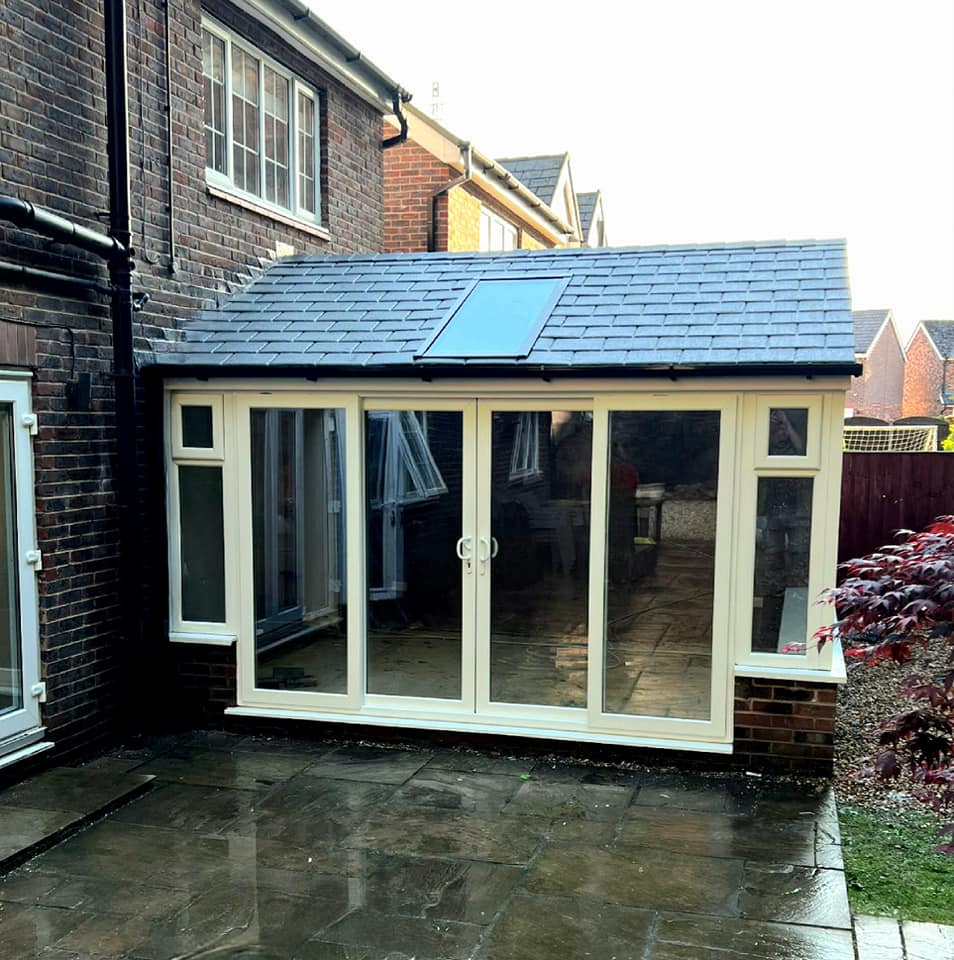
Importantly, both types can be retrofitted with a new roof system. An existing conservatory can be given an orangery-style appearance by replacing the glazed roof with a solid tiled or flat roof system and adding a perimeter fascia detail - often at significantly lower cost than demolishing and rebuilding.
Which Is More Expensive - Conservatory or Orangery?
A new orangery is considerably more expensive than a new conservatory to build from scratch. The masonry walls, plastered ceiling, and more complex roof lantern construction all add cost significantly compared to a standard conservatory.
However, if you already have an existing conservatory, the comparison changes entirely. Replacing a conservatory roof with a modern insulated tiled system creates a space that performs comparably to a purpose-built orangery for a fraction of the new-build price. Request a free quote to find out what a roof replacement would cost, or see our conservatory roof cost guide for a general overview.
Does an Orangery Need Planning Permission?
For a new-build orangery, planning permission is usually required. Orangeries are typically considered extensions rather than conservatories for planning purposes - because they do not meet the glazing proportion thresholds that qualify conservatories for permitted development exemption. The solid wall construction takes them outside the conservatory planning definition.
Converting an existing conservatory roof, however, is a very different matter. Replacing a polycarbonate or glass roof with a modern insulated system - without changing the footprint or increasing the height significantly - typically falls within permitted development and does not require planning permission. Building regulations approval is still required, but our team handles this process as part of every installation.
For a full guide to what approvals apply in your specific situation, see our page on planning permission for conservatory roof replacement.
Which Provides Better Insulation?
A new orangery with solid masonry walls and a well-specified roof lantern will outperform a new conservatory with polycarbonate or glass roof - there is no question about that. The solid walls contribute significantly to overall thermal performance, and orangeries typically achieve U-values of 0.20 to 0.28 W/m2K for the wall elements.
However, when comparing an existing conservatory with a modern replacement roof against a standard orangery, the picture changes. A conservatory with a warm roof replacement system achieving 0.15 W/m2K in the roof - the largest heat loss surface - will perform comparably in practice to many orangeries, particularly if the side glazing is double or triple glazed.
The roof is the dominant factor in conservatory thermal performance, accounting for 60 to 70 per cent of total heat loss. Replacing it with a high-performance insulated system addresses the most significant variable. See our conservatory roof insulation page for detailed U-value comparisons.
Can I Convert My Conservatory Into an Orangery?
Yes - and this is one of the most cost-effective home improvements available for conservatory owners. The conversion typically involves replacing the existing glazed roof with a solid insulated tiled or flat roof system and adding an external perimeter fascia to give the characteristic orangery "parapet" appearance from outside.
The result is a space that looks substantially like an orangery - solid roof, defined external perimeter line, plastered internal ceiling - without the cost of demolition and new-build construction. The existing frame, dwarf walls, and side glazing are retained, keeping the project cost well below that of a new-build orangery on the same footprint.
Which Adds More Property Value?
Both conservatories and orangeries can deliver a measurable increase in property value when well specified and properly built. The quality of construction and how well the addition integrates with the existing house matter more than the label applied to the structure.
From a value-per-pound-invested perspective, converting an existing conservatory with a replacement roof delivers outstanding results. It transforms a space that buyers and surveyors view negatively (uninsulated polycarbonate roof) into a genuine selling point, at a fraction of the cost of a new-build orangery. See our full analysis on our conservatory roof replacement value page.
What Are the Conservatory Roof Ideas Available?
Whether you are upgrading an existing conservatory or planning a new addition, there are more roof design options available today than most homeowners realise. From lightweight tiled systems in a range of profiles and colours, to solid flat roofs with internal lighting, to hybrid designs incorporating a glazed roof lantern panel within an otherwise solid roof - the variety is considerable.
For a full overview of styling and design options, see our conservatory roof ideas page, which covers the full range of replacement systems with visual examples.
To discuss whether a conservatory roof replacement, a conservatory-to-orangery conversion, or a new orangery is the right solution for your home, contact our team for a free consultation. You can also call us directly on 0151 453 9786.