
What Is a Warm Roof Conservatory? Complete Guide to How It Works
A warm roof conservatory uses continuous insulation above the structural deck, eliminating cold bridges and achieving U-values of 0.15 to 0.18 W/m2K - making it the highest-performing conservatory roof type available. If you have been researching conservatory roof replacements, you will have encountered the term "warm roof" frequently. This guide explains exactly what it means, how it differs from older construction methods, and why it matters for the temperature, energy efficiency, and long-term comfort of your conservatory.
What Is the Difference Between a Warm Roof and a Cold Roof?
The distinction between warm and cold roof construction is fundamental to understanding conservatory roof performance - and it comes down to where the insulation is positioned relative to the structural elements.
Cold roof construction
In a cold roof, insulation is placed between the structural rafters or joists. The structural elements themselves sit in the cold zone - that is, they are exposed to outside temperatures on one side. This creates thermal bridges: pathways through the structure where heat can escape relatively unimpeded. Cold bridges cause localised cold spots, increase heat loss, and create conditions where condensation forms on the structural members - leading to potential mould growth and deterioration over time. Cold roof construction is no longer considered compliant with current building regulations for conservatory roof replacements.
Warm roof construction
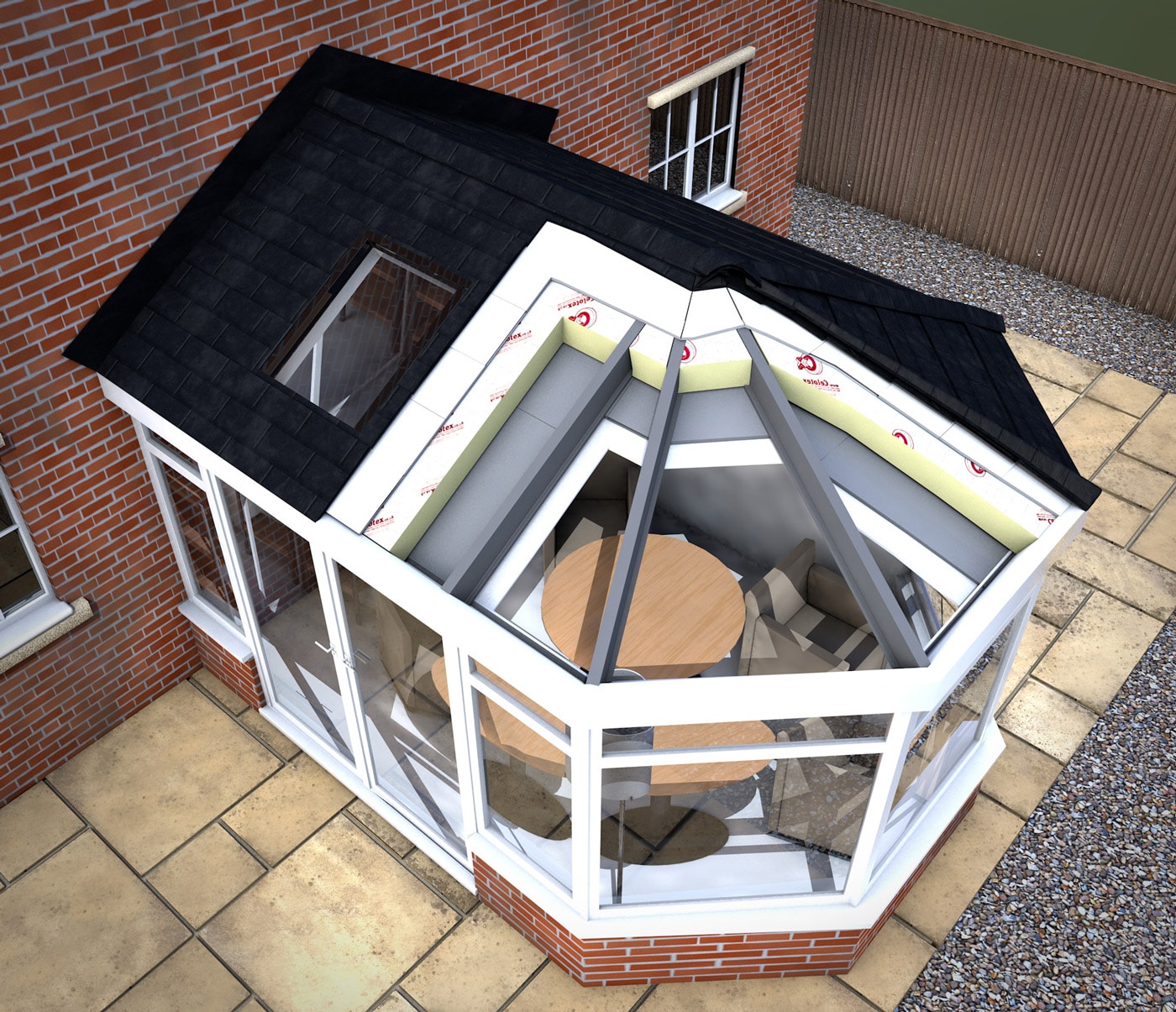
In a warm roof, a continuous layer of rigid insulation sits above the structural deck - on the outside, or "warm" side. The structural elements never drop below dew point temperature because they sit within the warm zone. There are no cold bridges, no condensation risk, and heat loss is minimised across the entire roof area. This is the standard required under current building regulations and is the construction method used in all modern conservatory roof replacement systems.
How Does a Warm Roof Conservatory System Work?
A warm roof conservatory is built in distinct layers, each performing a specific function. From the inside out, the typical layer sequence is as follows:
- Internal plasterboard and skim ceiling - the finished interior surface you see from inside
- A vapour control layer - prevents moisture-laden internal air from passing into the insulation zone
- The structural deck - typically oriented strand board (OSB) fixed to the roof frame
- Continuous rigid PIR (polyisocyanurate) insulation boards - the defining element of warm roof construction, providing the primary thermal barrier
- A weatherproof membrane or batten and counter-batten system to carry the external tile finish
- Lightweight concrete or composite roof tiles as the external weathering surface
Because the insulation is continuous and sits above the deck rather than between structural members, there are no gaps, no cold bridges, and no discontinuities in the thermal envelope. For more detail on how insulation specification affects performance, see our conservatory roof insulation guide.
What U-Values Does a Warm Roof Conservatory Achieve?
U-value is the measure of how quickly heat passes through a building element - lower values mean better insulation. For context:
- Standard polycarbonate conservatory roof: 1.6 to 2.0 W/m2K
- Double-glazed glass conservatory roof: 1.0 to 1.4 W/m2K
- Current building regulations requirement for replacement roofs: 0.18 W/m2K
- Modern warm roof conservatory systems: 0.15 to 0.18 W/m2K
The difference between a polycarbonate roof and a warm roof system is extraordinary - a warm roof loses heat roughly ten times more slowly. In practice, this means a conservatory that previously felt like an oven in July and a fridge in December can genuinely become a comfortable living space throughout the year, with no specialist heating beyond what your central heating system already provides.
Which Systems Use the Warm Roof Principle?
All of the major conservatory roof replacement systems available today use warm roof construction - this is not a premium add-on but a baseline requirement for building regulations compliance.
The Leka roof system is one of the most well-established systems using warm roof construction. It achieves excellent warm roof performance with an aluminium frame, offering a lighter alternative particularly suited to conservatories where structural load is a consideration.
Supalite, another leading system, also uses warm roof construction throughout. All three systems meet or exceed current building regulations and deliver the U-values required for year-round comfort.
What Does a Warm Roof Conservatory Cost?
The cost of a warm roof conservatory replacement depends primarily on the size of the existing roof area and the system chosen. Larger conservatories or those requiring structural reinforcement will sit towards the higher end of any range. The investment needs to be considered in the context of what it delivers - a permanent, building-regulations-compliant roof that eliminates the most significant single barrier to year-round conservatory use. Request a free quote for an accurate cost based on your property, or see our conservatory roof cost guide for a general overview.
Is a Warm Roof Conservatory Worth It?
For the vast majority of homeowners, the answer is yes. A warm roof conversion transforms a space that is functionally unusable for 6 to 8 months of the year into a comfortable room that can be used in every season. Energy savings on heating and cooling contribute to payback over time, though the primary driver for most homeowners is the dramatic improvement in liveability.
From a property value perspective, a conservatory with a building-regulations-compliant warm roof is an asset rather than a liability at point of sale - unlike an uninsulated polycarbonate-roofed addition, which buyers and valuers increasingly view as problematic. See our full assessment on our is conservatory roof replacement worth it page.
To discuss which warm roof system is right for your conservatory, contact our team for a free survey and no-obligation quote. You can also call us on 0151 453 9786 to speak with one of our specialists today.