
How to Make Your Conservatory Usable All Year Round
Making a conservatory usable all year round requires solving 3 problems simultaneously - overheating in summer, cold in winter, and rain noise throughout. Each of these problems has the same root cause: the roof. A polycarbonate or glass roof transmits heat freely in both directions and amplifies rain noise to the point where conversation becomes difficult. This guide explains what works, what does not, and what the most effective and permanent solution looks like for Liverpool homeowners.
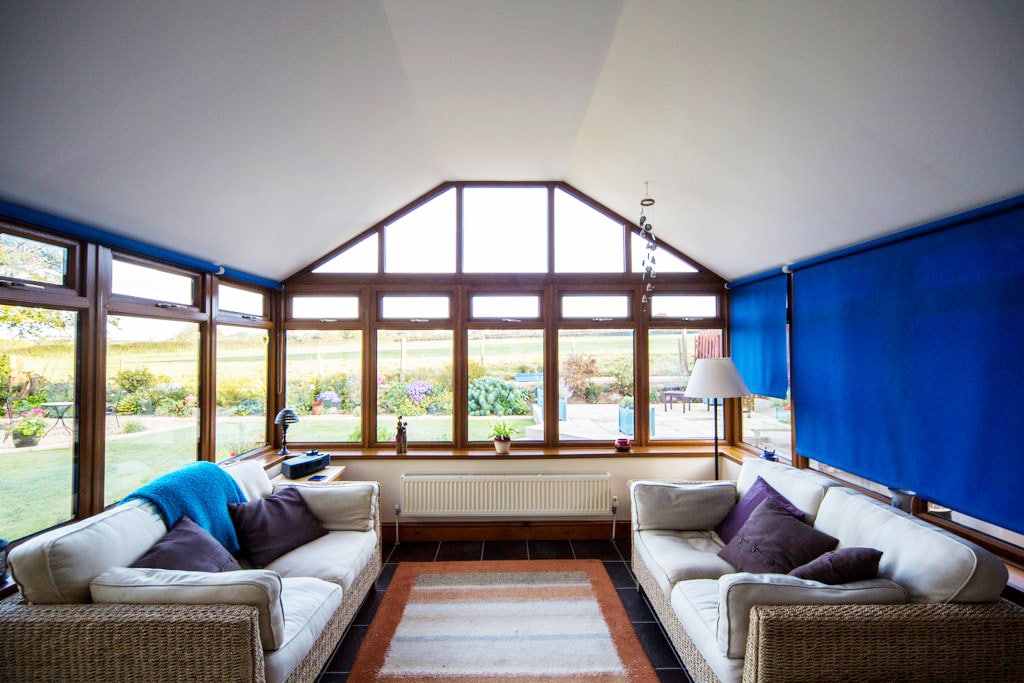
Why Can't I Use My Conservatory All Year Round?
The honest answer is that most conservatories were never designed for year-round occupation. They were designed as transitional spaces - sun rooms for fine days - and the planning exemptions that allow them to be built without building regulations compliance reflect that original purpose.
A polycarbonate roof offers virtually no insulation. In direct summer sunlight, internal temperatures can exceed 40 degrees Celsius - hot enough to cause genuine discomfort and potentially damage furniture. In winter, the same roof allows heat to escape rapidly, meaning the space drops to near-external temperatures overnight and struggles to warm up even with dedicated heating running continuously.
Glass roofs are marginally better but still achieve U-values of 1.0 to 1.4 W/m2K - compared to the 0.18 W/m2K target under current building regulations. Rain noise on both polycarbonate and glass is significant enough to be a genuine quality-of-life issue, particularly in North West England where rainfall is a consistent feature of the climate. For a detailed look at the summer overheating issue specifically, see our page on why your conservatory gets too hot in summer.
What Is the Most Effective Way to Make a Conservatory All Year Round?
Roof replacement is the only intervention that permanently addresses all three problems at once. A modern insulated roof system eliminates cold bridges (solving winter cold), provides thermal mass and solar blocking (solving summer overheating), and replaces the glazed surface with a solid tiled finish (eliminating rain noise entirely).
Other solutions - blinds, secondary glazing, portable heaters, cooling fans - treat the symptoms rather than the cause and deliver partial, temporary improvements at ongoing cost. A roof replacement is a one-time investment that changes the fundamental performance characteristics of the space.
The two primary options for a year-round conservatory roof replacement are tiled conservatory roofs - using lightweight systems such as Leka or Supalite - and solid conservatory roofs with a flat or low-pitch profile. Both use warm roof construction with continuous PIR insulation, achieving U-values of 0.15 to 0.18 W/m2K.
Does Insulation Alone Make a Conservatory All Year Round?
Insulation products retrofitted beneath an existing polycarbonate or glass roof - such as solid insulation boards, reflective foil systems, or replacement polycarbonate sheets with insulating properties - can reduce heat loss and partially reduce overheating. However, they deliver only partial improvement and do not resolve all three core problems.
Internally fitted insulation introduces cold bridges because the glazing bars and frame remain uninsulated. Rain noise persists. The improvement in winter warmth is real but limited, and summer overheating - driven largely by solar gain through the glazed surface - is addressed only marginally.
If budget is a genuine constraint, improved insulation is better than nothing. But if the goal is a space that functions as a comfortable living room in every month of the year, a full conservatory roof insulation upgrade as part of a complete roof replacement is the correct solution. Partial measures are likely to leave you dissatisfied and spending again within a few years.
What Heating System Works Best in a Year-Round Conservatory?
Once a proper insulated roof is in place, heating a conservatory becomes straightforward rather than challenging. The key change is that the space retains heat rather than losing it as fast as any heating system can generate it.
For most homes, the most practical solution is simply to extend the central heating system into the conservatory with one or two radiators. With a U-value of 0.15 to 0.18 W/m2K in the roof and adequate side glazing, a standard radiator sized for the room will maintain comfortable temperatures without excessive running costs.
Underfloor heating is an excellent option for conservatories with tiled or stone flooring, providing even heat distribution and eliminating the visual presence of radiators. Electric underfloor heating is the simplest retrofit option; wet underfloor systems can be connected to the existing boiler if the flooring is being upgraded simultaneously.
Electric panel heaters are suitable for conservatories used occasionally rather than daily, offering rapid heat-up from cold with no plumbing requirement. For a space used every day, central heating extension is more cost-effective to run.
Does Glazing Affect Year-Round Comfort?
The side glazing and windows of a conservatory do contribute to its thermal performance, but the roof is by far the largest variable. Studies consistently show that the roof accounts for 60 to 70 per cent of total heat loss in a standard conservatory - so improving glazing without addressing the roof delivers limited benefit.
That said, if you are investing in a roof replacement, it is worth reviewing the side glazing at the same time. Solar control glass reduces summer heat gain without reducing visible light transmission significantly. Self-cleaning glass reduces maintenance requirements, which is particularly relevant for south-facing conservatories. Low-emissivity (low-e) double or triple glazing improves the thermal performance of the side walls.
The most important glazing upgrade is the roof itself - and a modern tiled replacement roof eliminates the glazed roof surface entirely, replacing it with the highest-performing envelope element in the building.
How Much Does It Cost to Make a Conservatory All Year Round?
The primary investment is the roof replacement. The size of the roof, the system chosen, and any structural requirements all influence the final cost. See our full conservatory roof cost guide for a general overview, or request a free quote for an accurate price for your specific conservatory.
Additional items to consider include central heating extension, any glazing upgrades you choose to make simultaneously, and internal finishing such as plastering the new ceiling.
The return on this investment is significant. A comfortable, year-round conservatory adds functional floor space to your home, reduces heating costs wasted on an unusable space, and improves the saleability of the property. For a full assessment of the financial return, see our page on whether conservatory roof replacement is worth it.
Ready to make your conservatory usable all year round? Contact our team for a free survey and no-obligation quote, or call us directly on 0151 453 9786.